The right material and the right slab design depend on what will use the surface and on your lot. This page covers the choices people ask about before a pour. Prices are national published figures.
The price ranges on this page are national figures published by HomeGuide for 2026. They are not quotes from us. In Atlanta the slope of the lot, the red clay under the slab, truck access and local labor and material prices all move the number. Last checked October 2026.
Concrete or asphalt for a driveway?
Concrete costs more at the start and usually needs less upkeep. Nationally a concrete driveway is $6 to $15 per square foot and an asphalt driveway is $5 to $12 or more. Asphalt softens in strong sun, and Atlanta summers are long, so it can scuff and rut under turning tires and needs resealing through its life. Concrete stays hard in heat and reflects more light. Asphalt is easier to patch and hides stains better.
Poured concrete or pavers?
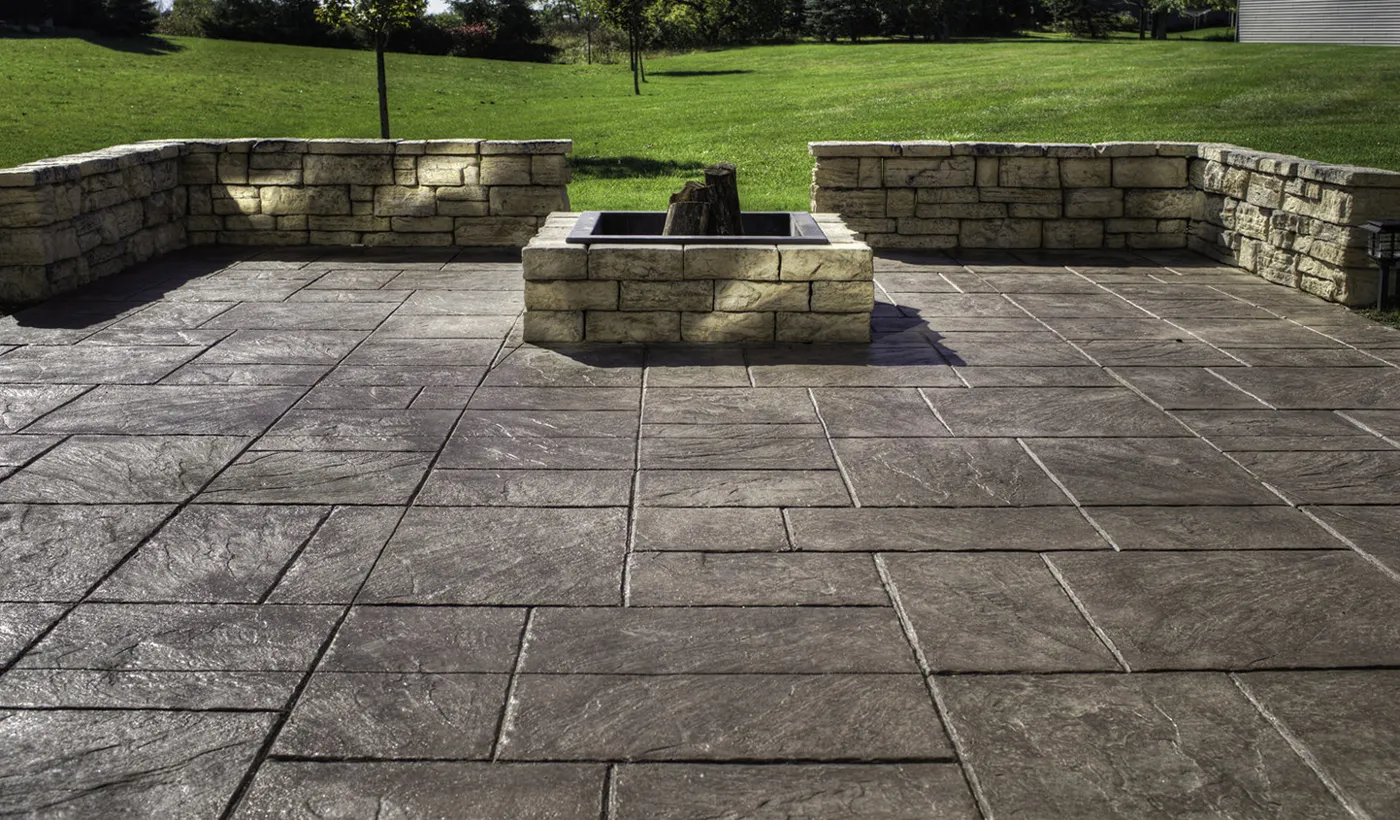
Pavers cost more for a patio and can be lifted and re-laid if something moves. A paver patio is $10 to $17 per square foot nationally, against $4 to $12 for plain concrete. On a slope, pavers need firm edge restraint or they creep downhill. Heavy rain can wash out the joint sand, and weeds and ants like the gaps. A poured slab is one piece and sheds water faster. Pavers do let a little rain soak in, which some owners want near trees.
How thick should a concrete driveway be?
Four inches is the usual minimum for a driveway that carries cars and light trucks. Go to 5 or 6 inches where heavier vehicles park or cross, and thicken the edges on a steep drive so runoff cannot undercut them. By national figures a 4-inch slab is $6 to $8 per square foot and a 6-inch slab is $8 to $10. Thickness is easy to skimp on, so have it stated in the quote.
Do I need rebar or wire mesh?
For most Atlanta driveways we would include one of them. Rebar or wire mesh does not prevent cracks. It keeps the two sides of a crack tight and level. That matters on sloped ground, over backfilled areas near the house and over utility trenches. Rebar on supports is stronger than mesh, and mesh only works if it is lifted into the middle of the slab and not left lying on the dirt.
What PSI concrete do I need?
The mix strength, given in PSI, should suit the use. Residential flatwork is commonly specified in the 3,000 to 4,000 PSI range, with the higher end used for driveways. The ready-mix supplier can match a mix to the job. A good mix placed badly still fails, so base, water control and curing count for at least as much as the PSI on the ticket.
Is stamped concrete worth it?
It is worth it if you like the look and will keep up the sealer. Stamped concrete costs $8 to $19 per square foot nationally, compared with $4 to $12 for a plain patio. You get the appearance of stone or brick in one slab, with no joints to shift or sprout weeds. The trade-offs are a sealer that needs renewing, a surface that can be slick if the wrong sealer is used, and repairs that are hard to blend in.
Should I seal my new concrete, and how often after that?
Sealing is a choice for plain broomed concrete and close to a must for stamped or colored work. Let the slab cure first. About a month is the common guide for most sealers, but follow the product label. How often you reseal depends on sun, traffic and the product, and every two to three years is a typical interval for decorative work. Cleaning and sealing costs $1 to $3 per square foot nationally, or $575 to $1,700 for a two-car driveway.
Broom finish or smooth finish? And what about a steep driveway?
Use a broom finish outdoors. A smooth troweled finish belongs in a garage or shop, because it is slick when wet. On a steep driveway, which Atlanta has many of, ask for a heavy broom finish pulled across the slope, so the grooves give the tires something to bite on and lead water to the sides. Very steep drives may also have grooves cut or formed into the surface.
What does a hot tub pad need?
A hot tub pad needs to be flat, thick enough for the load and sitting on a well-compacted base. A filled tub with people in it weighs several thousand pounds, so give us the maker's weight figure. A reinforced slab on compacted stone is the usual answer. Plan the electrical conduit before the pour, and keep the pad off freshly filled ground at the top of a slope.
What slab do I need for a shop with a vehicle lift or heavy equipment?
Start with the lift maker's requirements. A vehicle lift puts its load into a few anchor points, and the manufacturer states the minimum slab thickness and concrete strength for them. A standard 4-inch floor is often not enough. Tell us the lift model and the heaviest thing you will park, and the slab can be thickened under the posts or throughout.
Do I need gravel under a slab, and do I need a vapor barrier?
On Atlanta clay, yes to the gravel. A layer of compacted crushed stone gives the slab even support and lets water drain from beneath it. Clay alone holds water and softens. A vapor barrier is plastic sheeting under the concrete. It belongs under indoor floors, such as a garage, shop, basement or any slab that will get flooring or a coating. Driveways and open patios do not need one.
What kind of pad do I need for delivery trucks?
A pad that takes a delivery truck needs more than a home driveway. Loaded box trucks, dumpster trucks and concrete mixers are far heavier than cars. Expect a thicker slab, a stronger mix, a deeper stone base, rebar and tighter joint spacing. Tell us the truck type and how often it comes. For a business this is priced from a site visit.
My pool deck is worn. Resurface, pavers or new poured concrete?
If the deck is solid and only looks tired, resurface it. Pool deck resurfacing is $3 to $6 per square foot nationally. If parts have sunk or cracked through, replace those parts, since an overlay will crack with them. Pavers are an option where you want access to lines under the deck. For any pool deck, pick a textured, light-colored finish that grips wet feet and does not get too hot in the Georgia sun.
My patio will be poured against the house. What goes between them?
An isolation joint. That is a strip of compressible material placed between the new slab and the foundation, steps or posts, so the patio can move a little without pushing on the house or cracking against it. The top is often sealed to keep rain out. The patio also has to slope away from the wall so water does not sit at the foundation.
The real price for your property comes from a free on-site estimate and a written quote. Call (678) 736-8780 or send us a photo of the concrete.